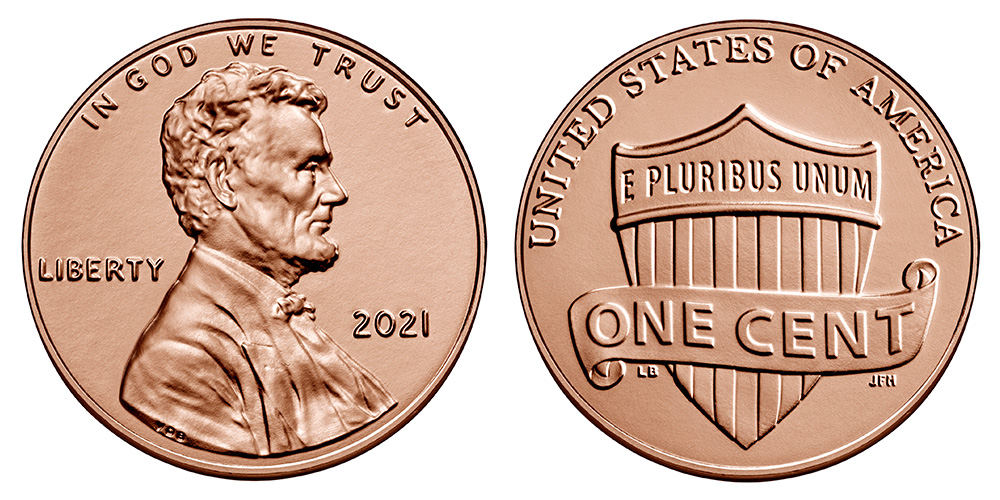
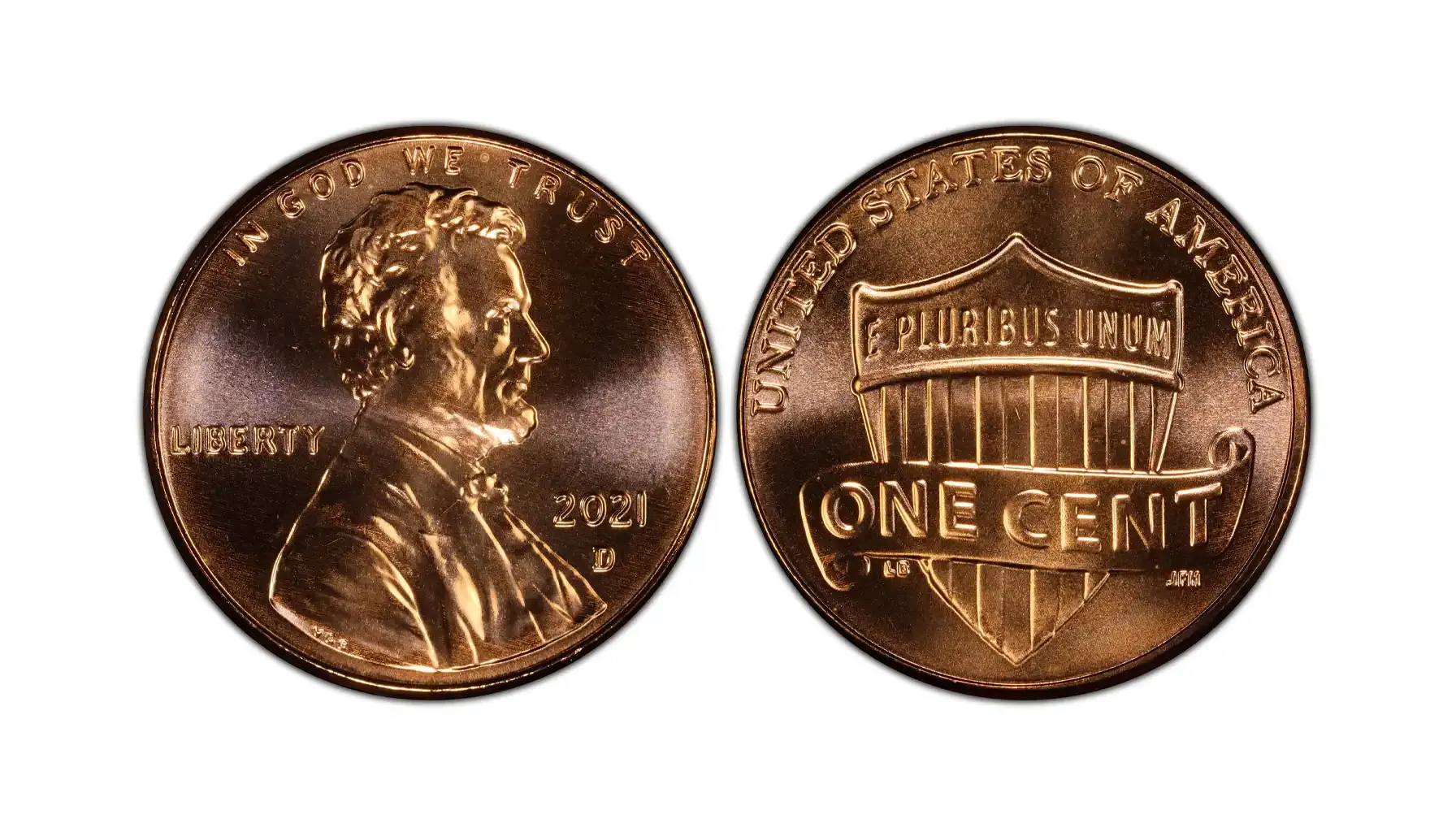
A 2021 Lincoln Shield penny graded PCGS MS69RD sold for $4,646 — but billions were made, so most are worth 1¢ in pocket change. The difference? Condition, color, and the right minting error. The Spiked Head die crack alone can push a common cent past $100 in uncirculated grades. Use the free tools below to find out exactly what yours is worth.
The value of a 2021 Lincoln Shield cent depends primarily on its mint mark and grade — then dramatically on errors. For a step-by-step 2021 penny identification walkthrough with detailed grading photos, the complete reference covers every major variety and condition tier.
| Variety | Worn / Circulated | AU (About Uncirculated) | MS60–MS65 (Uncirculated) | MS67+ (Gem) |
|---|---|---|---|---|
| 2021 No Mint Mark (Philadelphia) | $0.01 | $1 – $2 | $3 – $36 | $55+ |
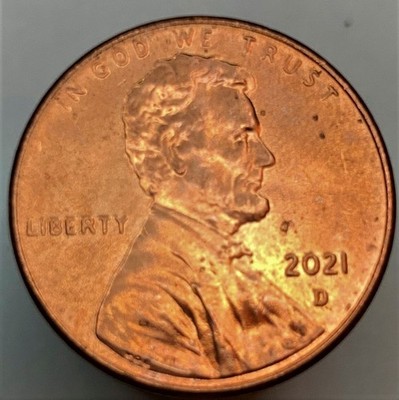
| 2021-D (Denver) | $0.01 | $1 | $1 – $55 | $55 – $3,300 |
| ⭐ Spiked Head Die Crack (P or D) | $10 – $30 | $20 – $60 | $30 – $100 | $100+ |
| 🔴 Rim-to-Rim Die Crack (P) | $30 – $100 | $100 – $300 | $200 – $500 | $500 – $800+ |
| Doubled Die Obverse (P or D) | $10 – $20 | $20 – $60 | $50 – $150 | $150 – $200+ |
| Off-Center Strike (P or D) | $20 – $40 | $30 – $60 | $50 – $150 | $150+ |
| 2021-S Proof (San Francisco) | N/A | N/A | $3 – $10 | $30 – $92 |
★ Row = Spiked Head (most iconic variety) · 🔴 Row = Rim-to-Rim Die Crack (highest error value). RD (Red) designation required for top-tier prices.
🪙 CoinHix lets you estimate your 2021 penny's grade and cross-check its current value in seconds — a coin identifier and value app.
Despite being produced in the billions, 2021 Lincoln Shield cents developed a surprisingly rich array of die errors and striking anomalies. These errors transform a one-cent coin into a collectible worth anywhere from a few dollars to several hundred. Below are the five most significant varieties, ranked by collector demand and market value. Each card explains what to look for, why it happened, and what it's currently fetching at auction.
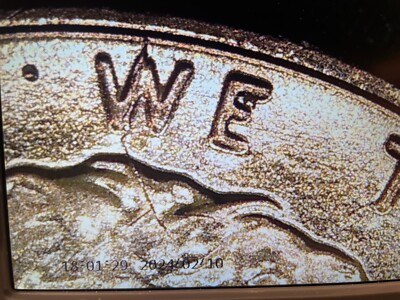
The Spiked Head is the most visually striking and most widely collected 2021 penny error. It results from obverse dies that cracked during the production run, most commonly in the area above Lincoln's portrait and near the IN GOD WE TRUST motto. As the die fracture widened under repeated striking pressure, excess metal was forced into the crack, creating spike-like projections that appear to radiate from Lincoln's head. Multiple dies at both Philadelphia and Denver developed this characteristic pattern in 2021, making it one of the more accessible errors for beginning collectors to encounter in circulation.
Visually, the Spiked Head is unmistakable when pronounced: look for irregular raised metal spurs protruding above the hairline or from the field near the bust. The spikes are usually 1–3mm in length on strong examples. Under a 10× loupe, you can trace the crack line back from the spike to its origin die fracture. Weaker examples show only small raised bumps that could be confused with die chips — a complete crack trace distinguishes genuine Spiked Head varieties from lesser chip errors.
Collectors prize the Spiked Head variety because it's dramatic enough to be appreciated without magnification, unlike many micro-variety errors. Strong examples in circulated condition can fetch $10–$30, while uncirculated specimens with well-defined spikes command $50–$100 or more depending on the prominence of the spike and the coin's overall eye appeal. The Denver Mint version is considered slightly more common, while Philadelphia examples with multiple pronounced spikes attract premium bids.
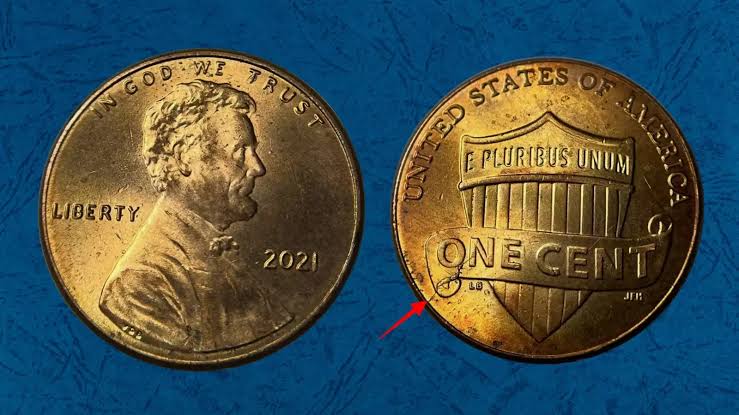
The Rim-to-Rim Die Crack is the most valuable die error variety in the 2021 Lincoln cent series. Unlike the localized Spiked Head error, a rim-to-rim crack means the obverse die developed a fracture that ran completely across its face — from one edge of the die to the opposite edge. Every coin struck by that damaged die reproduced this crack as a raised metal line traversing the full diameter of the coin. When the crack crossed Lincoln's chest and the field, the resulting coins are dramatic and immediately recognizable without any magnification at all.
Visually, you're looking for a raised, irregular line crossing the obverse from rim to rim, passing through the design elements. On the most prized Philadelphia examples, this crack passes through or near Lincoln's chest, effectively bisecting the obverse design. On some coins the crack appears broader or shows branching, indicating advanced die deterioration. Unlike post-mint damage (such as a scratch), a genuine die crack line is always raised above the coin's surface and perfectly consistent in character across multiple known examples.
Market values for this variety range from $30 for modest circulated examples to $800 or more for dramatic, sharp specimens in uncirculated condition. The coin reportedly sold for amounts in this range on eBay based on documented listings. Premium is driven by the crack's width, length, and how dramatically it bisects the design. Coins where the crack clearly runs rim-to-rim without interruption attract the most competitive bidding from die variety specialists and error coin collectors alike.
The 2021 Doubled Die Obverse results from a hubbing error during die manufacture. The master hub imprints the design onto the working die in multiple passes; if the die shifts slightly between passes, a secondary image of the design elements appears at a different angle or position. On 2021 cents, this manifests as visible doubling on the motto IN GOD WE TRUST, the word LIBERTY, or the date — the three lettering zones most frequently affected by hub misalignment. Unlike mechanical doubling (a flat, shelf-like shadow), a true DDO shows a distinct, separate letter image with its own raised profile under magnification.
To identify the 2021 DDO under a 10× loupe, examine the letters of IN GOD WE TRUST from left to right. True doubled die doubling appears as a complete second letter clearly separated from the first — each letter has its own raised surfaces. Mechanical doubling, by contrast, looks like a flattened shelf on one side of the letter. Also check the date digits and LIBERTY on the obverse rim. On strong specimens, doubling on two or more distinct words is diagnostic and rules out most counterfeits or false positives from post-mint damage.
The 2021 DDO is not as widely catalogued as doubled dies from older Lincoln Memorial cents, but collector demand is growing as the series ages and registry set builders search for top-pop examples. Circulated examples with visible doubling bring $20–$50; uncirculated examples in MS63–MS65 fetch $50–$150. In gem MS66+ grades with full RD color, values can exceed $200, particularly for examples slabbed by PCGS or NGC where the designation confirms authenticity. The DDR (Doubled Die Reverse) on the shield design is also documented and commands similar premiums.
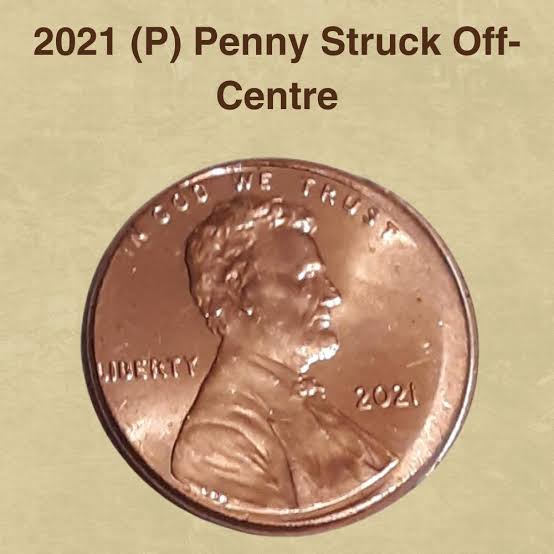
An off-center strike occurs when a planchet (blank coin disc) is not properly centered between the dies at the moment of striking. The U.S. Mint's automated feeding system normally aligns each planchet precisely, but occasional mechanical failures allow a blank to enter the striking chamber partially off-position. The resulting coin shows the full design on one portion and a blank, unstruck crescent on the other. On 2021 Lincoln cents, off-center strikes have been found ranging from slightly misaligned (5–10% off) to dramatically displaced (40–50% off center), with the date still visible on examples shifted toward the top or left.
Value increases proportionally with how far off-center the strike is — but only if the date remains fully visible. A 2021 penny struck 50% off-center with a legible date is worth significantly more than one only 10% off. Look for the bright crescent of unstruck planchet metal and confirm the design that is present shows a clear date. The collar that normally constrains the planchet's edges is also absent or partial, so off-center coins often show an irregular, spread edge rather than the standard reeded-free plain edge of normal cents.
On the open market, modest off-center 2021 cents (10–15% off) fetch $20–$40. More dramatic examples at 25–30% off bring $50–$100. Extreme examples (40%+ off with full date visible) can command $100–$150 or more in uncirculated condition. Because these are struck errors rather than die errors, each example is unique in its exact offset percentage and orientation. Error coin specialists grade both the degree of misalignment and the coin's overall surface quality when assigning value.
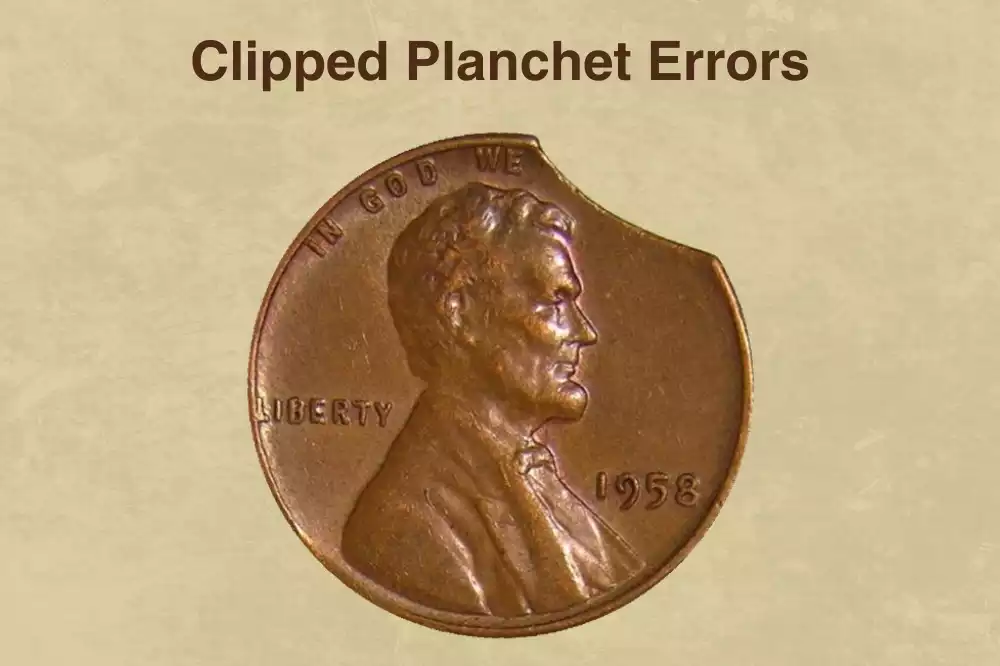
The clipped planchet error originates at the very beginning of the coin production process — before a single die ever touches the metal. Penny planchets are punched from long coils of copper-plated zinc strip. If the blanking punch descends too close to a hole already cut in the strip, it will capture the edge of the previous hole, removing a curved crescent of metal from what becomes the coin's edge. The result is a coin that is noticeably missing a curved section, typically 2–5mm wide, anywhere along its circumference. This is distinct from post-mint damage (which leaves a rough or jagged edge) because the original curved missing section has a smooth, clean internal edge from the blanking punch itself.
Identification requires examining the coin's edge carefully around its full circumference. A genuine clipped planchet shows a concave crescent with a smooth punch-cut inner edge, and the coin's design elements near the clip may show compressed or missing lettering (a diagnostic feature collectors call the "Blakesley effect" — thinning of the opposite rim). The Blakesley effect helps distinguish genuine clips from filed or damaged coins where the opposite rim remains normal. Straight clips (from the edge of the metal strip rather than a prior hole) also occur and show a flat, linear missing section.
On the 2021 cent, clipped planchets are among the more accessible errors to find because they can occasionally survive into circulation and be discovered in pocket change — unlike die errors which are more easily spotted at the mint. A modest curved clip brings $10–$20. A larger, dramatic clip (removing 15–20% of the planchet) in uncirculated condition with a clearly visible Blakesley effect can fetch $30–$50, and exceptionally large clips occasionally reach higher. Multiple clips on a single 2021 cent are extremely rare and would command specialist premiums substantially above these baseline figures.
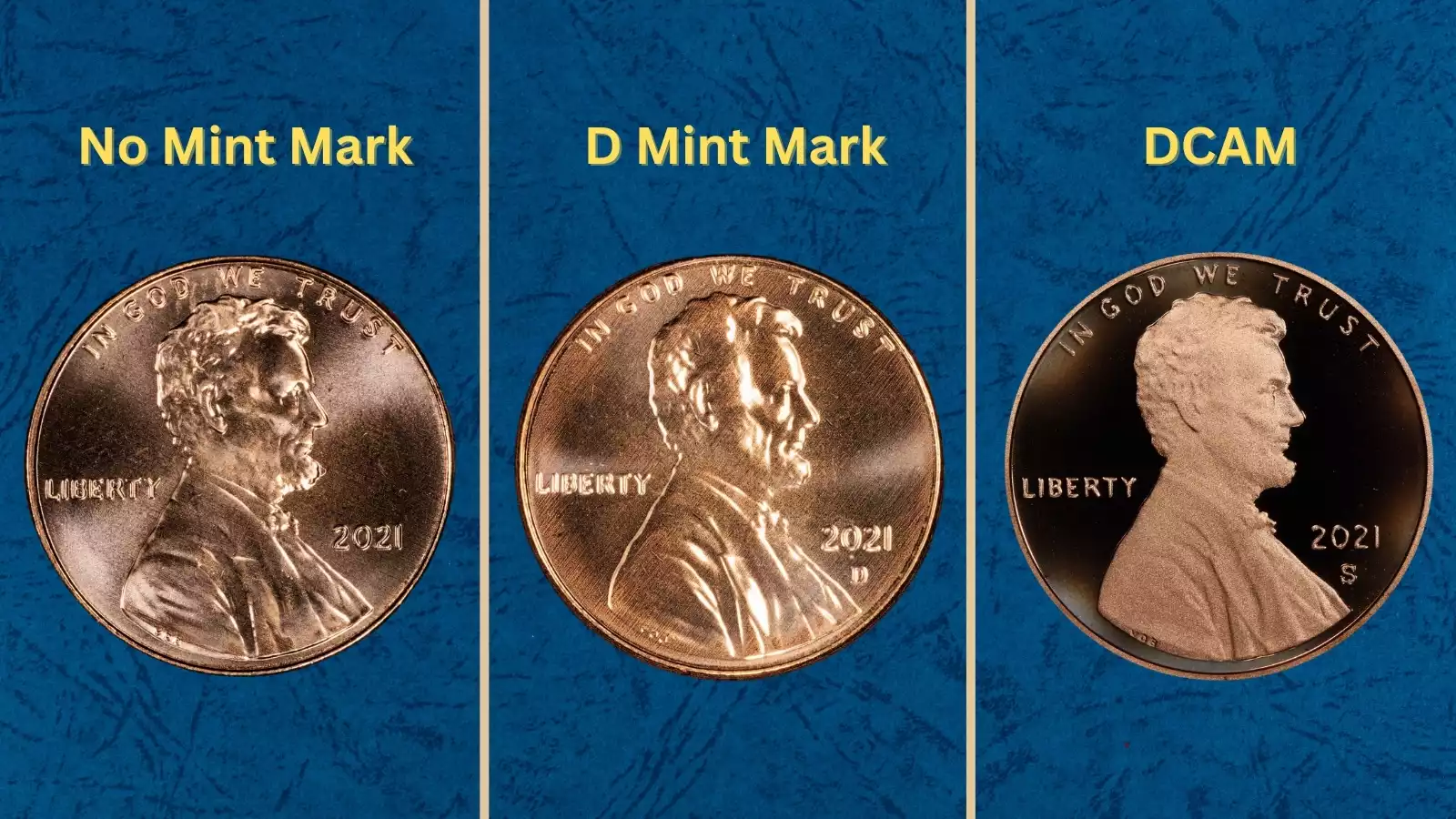
The 2021 Lincoln Shield cent was struck in enormous quantities at two facilities for general circulation, with a small collector-only issue at San Francisco. The combined circulation mintage approached 7.9 billion coins, making these among the most commonly produced Lincoln cents in recent decades. Despite this enormous production, true gem-quality survivors represent only a tiny fraction of total output.
| Mint | Mint Mark | Mintage | Type | Note |
|---|---|---|---|---|
| Philadelphia | None | 3,925,820,000 | Business Strike | General circulation |
| Denver | D | 3,982,800,000 | Business Strike | General circulation |
| San Francisco | S | 857,079 | Proof (DCAM) | Collector sets only; never circulated |
| Total | — | 7,909,477,079 | — | Combined all mints |
Survival note: Of the nearly 4 billion Philadelphia and Denver coins struck for circulation, the vast majority entered commerce and are now worn. Truly uncirculated examples grade MS60–MS65, but finding a gem MS67 or MS68 with full RD color requires fresh original-roll or original-bag examples. The Philadelphia penny's PCGS MS69RD sale at $4,646 underscores just how few coins achieve that stratospheric grade from a production standpoint — even among billions of coins struck.
Grading a copper-plated zinc cent requires assessing three factors: surface wear, contact marks, and color. RD (Red) designation is the key premium driver — and it requires retaining 95%+ original copper-red luster.
Lincoln's cheek, jaw, and the high-relief hair above the ear show smooth flatness from circulation wear. The shield lines on the reverse may be partially merged. These coins are safe to spend — worth face value only.
Light wear on the highest points of Lincoln's portrait with most design detail intact. At AU grades, only trace wear is visible under magnification. Original mint luster is absent or broken. Still face-value territory for most examples.
No wear whatsoever — but contact marks from coin-to-coin bag contact are visible. MS65 (Gem) examples show only a few scattered small marks and retain full luster with an attractive appearance. Color determines whether the coin grades RD, RB, or BN.
Near-perfect surfaces with minimal to no visible contact marks under magnification. Full original RD (Red) luster mandatory for top prices. MS68 RD examples fetch hundreds; the rare MS69 RD can reach thousands at auction from major registry-set collectors.
📱 CoinHix can match your 2021 penny photos against certified graded examples to help you narrow down its condition before submitting for professional grading — a coin identifier and value app.
Is the coin in front of you really a Spiked Head variety — or just a normal 2021 cent with a damaged surface? Use the comparison below and the 4-point checklist to find out in 60 seconds.
Check all that apply to your coin:
Select your coin's mint mark, condition, and any errors to get an instant value estimate based on current market data.
If you're not yet sure of your coin's mint mark, condition, or errors, there's a 2021 Penny Coin Value Checker free tool that lets you upload a photo for an instant AI-assisted assessment before coming back here to calculate.
Not sure which buttons to press? Describe your 2021 penny in plain English and get a tailored analysis with value context and next steps.
Choosing the right venue depends on what type of 2021 penny you have — an error coin, a high-grade gem, or a circulated example. Each market reaches a different buyer pool.
Best for PCGS/NGC-graded gem examples (MS67 RD or better) and dramatic error coins that can compete for multiple bidders. Heritage's Lincoln cent specialist buyers regularly follow 2021 high-grade lots. Their buyer's premium is around 20%, so the coin needs to be worth at least $100–$200 to justify the submission process. Ideal for that MS68 or MS69 if you have one.
The largest market for raw (ungraded) and lower-value 2021 pennies, including common errors and circulated specimens. Check recently sold 2021 Shield penny prices and completed auction results to price your coin realistically before listing. Filter by "Sold" listings rather than active asking prices — sold data shows what buyers actually paid.
Fast and convenient for immediate cash offers — dealers typically pay 40–60% of retail value on modern cents, so only viable for error coins with clear premium value or rolls of uncirculated examples. Bring your die crack or off-center strike rather than a worn circulated cent. A local shop can also advise whether your coin merits professional grading before a bigger sale.
An excellent free resource for getting community opinions on whether your 2021 penny error is genuine before spending money on grading. Post clear photos under good lighting (raking side-light for die cracks) and experienced collectors will weigh in. The /r/coincollecting community is particularly active on modern Lincoln cent errors and can help distinguish genuine varieties from damage.
Professional grading by PCGS or NGC adds significant buyer confidence and typically increases realized prices for 2021 pennies that can reach MS68 or higher with RD designation. However, grading fees ($30–$60 per coin) mean you need a confident path to at least MS67 RD to break even. An NGC MS67 RD might sell for $25–$60, barely covering fees. Reserve third-party grading for genuine gem examples or dramatic error coins where the authentication label itself adds value — like a documented rim-to-rim crack or a clean off-center strike in uncirculated condition.
Most circulated 2021 pennies are worth only face value — 1 cent. Uncirculated examples in MS60–MS65 range from about $1 to $10. Gem-quality specimens graded MS67 or higher command $30–$55 or more. Error coins like the Spiked Head die crack or doubled die obverse can bring $30 to $800. Top-certified MS69 examples have sold for over $4,600 at auction.
A PCGS-certified 2021 Philadelphia penny graded MS69RD sold for approximately $4,646. This extreme premium is driven by registry set collectors competing for the highest-graded examples. The 2021-D penny holds its own auction record of $3,300 for a PCGS MS68RD example sold on eBay in December 2022. Coins below MS68 rarely justify third-party grading costs.
The Spiked Head is a die crack error on 2021 pennies where the obverse die developed cracks near Lincoln's head, producing spike-like metal projections. Multiple dies at both the Philadelphia and Denver mints showed this pattern. It's the most recognizable 2021 penny error and is popular with beginning collectors. Values range from a few dollars raw to $30–$100 for especially pronounced examples in uncirculated condition.
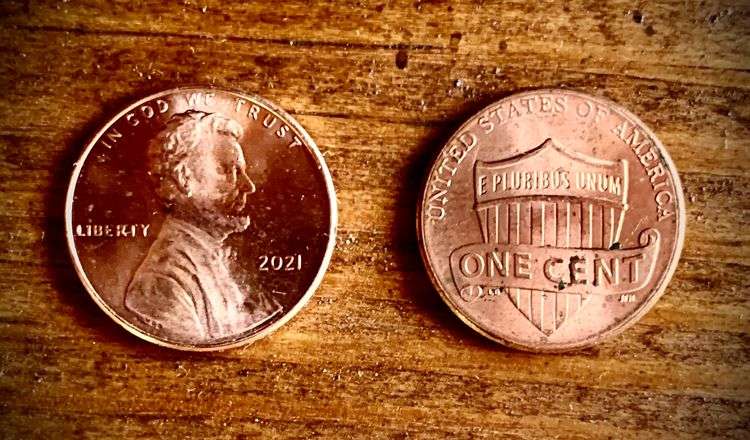
A 2021 penny with no mint mark was struck at Philadelphia. Circulated examples are worth face value. In uncirculated MS60–MS65 condition they're worth $1–$10. At MS67 grade expect $30–$55. The key to premium value is the RD (Red) color designation — coins that retain full original copper-red luster command a significant premium over RB (Red-Brown) or BN (Brown) examples at every grade level.
The 2021-D penny (Denver Mint) had a mintage of approximately 3.98 billion — similar to Philadelphia. Circulated examples are worth 1 cent. Uncirculated specimens in MS60–MS65 fetch $1–$10. An MS67RD can bring $30–$60. The Denver Mint's top sale was $3,300 for a PCGS MS68RD example in December 2022. Denver coins are sometimes perceived as slightly better quality than Philadelphia, though values are broadly similar.
The 2021-S penny was struck exclusively at San Francisco as a collector proof coin, with a mintage of approximately 857,000. These were never released for circulation. In PR65DCAM condition they're worth about $3–$5. High-quality PR70DCAM First Day of Issue examples have sold for around $92. They're included in U.S. Mint proof sets and are not found in everyday pocket change.
The most valuable 2021 penny errors include the Rim-to-Rim Die Crack ($30–$800 depending on condition), the Spiked Head Die Crack ($10–$100), Doubled Die Obverse ($20–$200), Off-Center Strike ($20–$150 depending on how far off-center), and Clipped Planchet ($10–$50). A multiple-error coin combining two or more defects can command the highest premiums. Die chip and struck-through errors are also collected.
For most 2021 pennies, grading fees ($30–$60 per coin) exceed the coin's market value unless you believe it grades MS68 or higher. An NGC MS67 example might sell for only $12–$25, making grading economically unwise. However, if you have an error coin or a pristine gem that might grade MS68+, professional grading by PCGS or NGC significantly increases buyer confidence and can justify the cost substantially.
Examine the lettering on the obverse — IN GOD WE TRUST, LIBERTY, and the date — under a 10× loupe. A genuine doubled die obverse (DDO) shows a distinct second image of the letters or numbers, not a simple blurry shadow. On the reverse, check the shield's vertical lines and the lettering for similar doubling. Mechanical doubling (MD) appears as flat shelf-like doubling and is much less valuable than a true doubled die from the hubbing process.
RD stands for 'Red' — the color designation PCGS and NGC assign to copper and copper-plated coins. An RD designation means the coin retains 95% or more of its original mint-red luster. RB (Red-Brown) coins retain 5%–95% red color. BN (Brown) coins have oxidized to a mostly brown surface. For 2021 pennies, the RD designation is critical: an MS67RD can be worth several times more than the same coin graded MS67RB.